Fresh off the energy of Swetugg 2026 in Liljeholmen, it’s clear that while the AI hype train is still roaring, the community's focus is shifting toward pragmatic implementation, sustainable infrastructure, and the robust new capabilities of .NET 10.
From the depths of the ocean to the cutting edge of local AI, here are the technical highlights and architectural takeaways from two days of deep dives.
Day 1: Modern APIs, Distributed Systems, and Edge AI
Mastering OpenAPI in .NET 10
Speaker: Sander ten Brinke
As we move into the .NET 10 era, the way we document and consume APIs is becoming more integrated into the development lifecycle.
Sander emphasized moving beyond basic documentation toward a "build-time" approach. By using the Microsoft.AspNetCore.OpenApi package (and the ApiDescription.Server NuGet), developers can now generate API documentation during the build process.
This is a gamechanger for PR reviews, allowing teams to see exactly how an endpoint's contract has changed before it ever hits a staging environment.
Technical Deep Dive: TypedResults vs. ProducesResponseType
-
TypedResults: In .NET 10, favor TypedResults. It provides strong typing for your responses, making your code cleaner and allowing the OpenAPI generator to infer response types automatically without extra attributes.
-
ProducesResponseType: Keep this for legacy controllers where you need to explicitly define metadata for the OpenAPI document, though it’s increasingly seen as the more verbose, manual way.
Tool Spotlight: Developer Flow
-
CodeTour: Use this VS Code Extension to create guided walkthroughs of your codebase.
-
DemoTime: Perfect for presenters, this tool helps automate VS Code setups for live demos.
Resources & Demos:
OpenAPI Tools Curator
ASP.NET Core OpenAPI Docs
Demo: OpenAPI .NET Talk GitHub
Distributed Systems with Aspire and Dapr
Speaker: Nico Vermeir
Nico explored the "Trenches" of distributed architecture, focusing on the synergy between .NET Aspire (the orchestrator) and Dapr (the runtime). The core takeaway: Aspire simplifies the inner-loop development, while Dapr handles the "sidecar" complexities of state management and service invocation.
Resources & Demos:
Aspire Dapr Demo GitHub
Official Aspire Docs
Offline AI in .NET MAUI
Speaker: Codrina Merigo
AI doesn't always need the cloud. Codrina showcased how to build privacy-first, offline-capable AI experiences using .NET MAUI. The focus was on local execution via ONNX and tools like CustomVision.com for model training.
Extra Learning: Demoing Mobile
Use Vysor to mirror and demo your local phone screen during presentations, it’s significantly more reliable than standard emulators for AI workloads.
The Undersea Cable Network: The Internet's Physical Backbone
Speaker: Richard Campbell
Watch the Full Session
Richard Campbell took us on a fascinating "Geekout" into the literal physical connections that hold the world together. Despite our obsession with satellites, 97-98% of all global data travels through over 2 million kilometers of undersea cables.
The Power Paradox: Modern cables aren't just for data; they carry high-voltage electricity to power repeaters every 50-100km to boost the signal as light scatters inside the glass.
The "Accidental" Weaponization: Campbell detailed recent incidents in the Baltic and Red Seas where anchor drags, some suspiciously timed, have caused tens of millions in damages, proving how vulnerable our "invisible" infrastructure truly is.
Day 2: Algorithms, Reusable Code, and the AI Reality Check
Algorithms Demystified
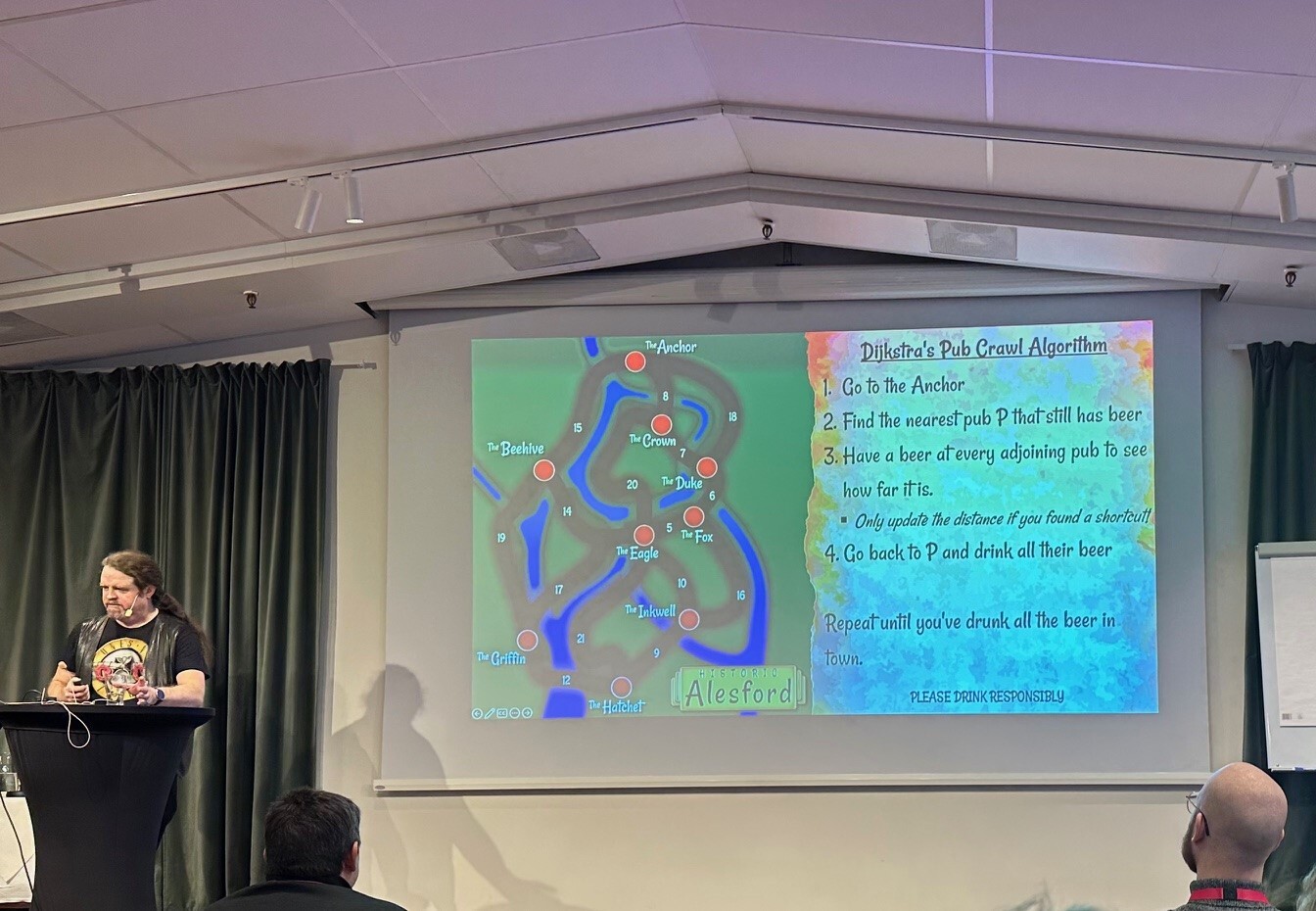
Speaker: Dylan Beattie